Scales · PDF
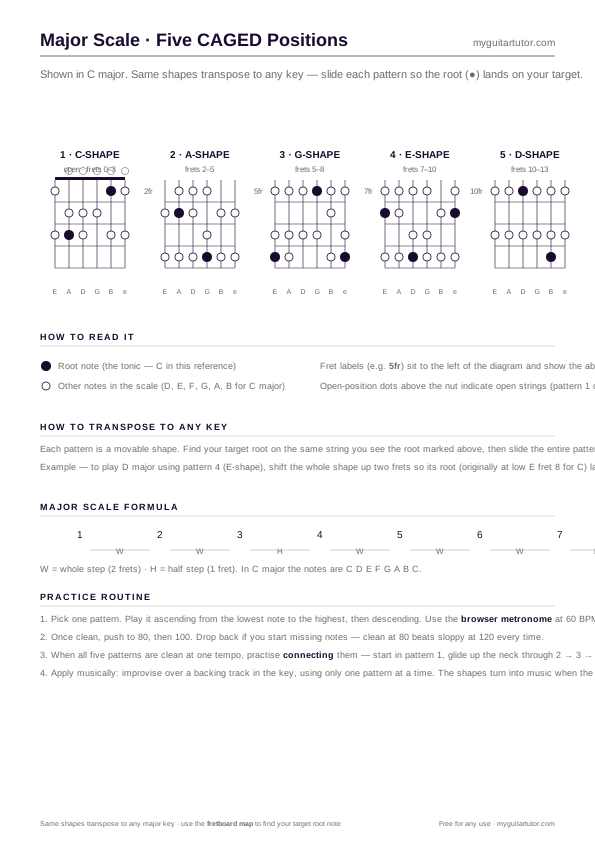
Major Scale · Five CAGED Positions
A printable reference showing all five CAGED-system fingerings of the major scale, with root notes highlighted. Transposable to any key.
A minor is the natural starting point for most lead-guitar work — the natural minor scale starts at fret 5 of the low E, the chords sit in the most ergonomic part of the neck, and three of the four most useful pentatonic positions are inside the first 12 frets. This hub bundles every resource and tool worth reaching for when you're drilling in A minor.
In this hub
A printable reference showing all five CAGED-system fingerings of the major scale, with root notes highlighted. Transposable to any key.
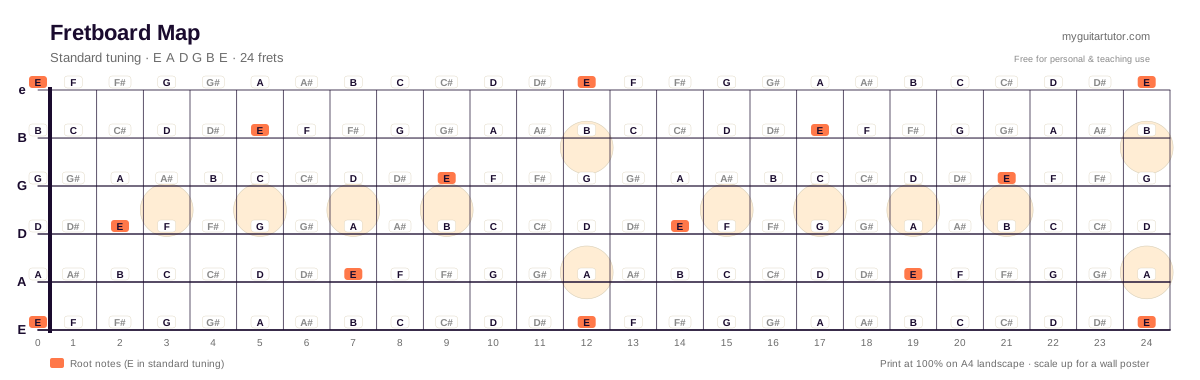
Full 24-fret fretboard diagram showing every note in standard EADGBE tuning. Sharps and flats both labelled. Inlay dots at the usual positions.
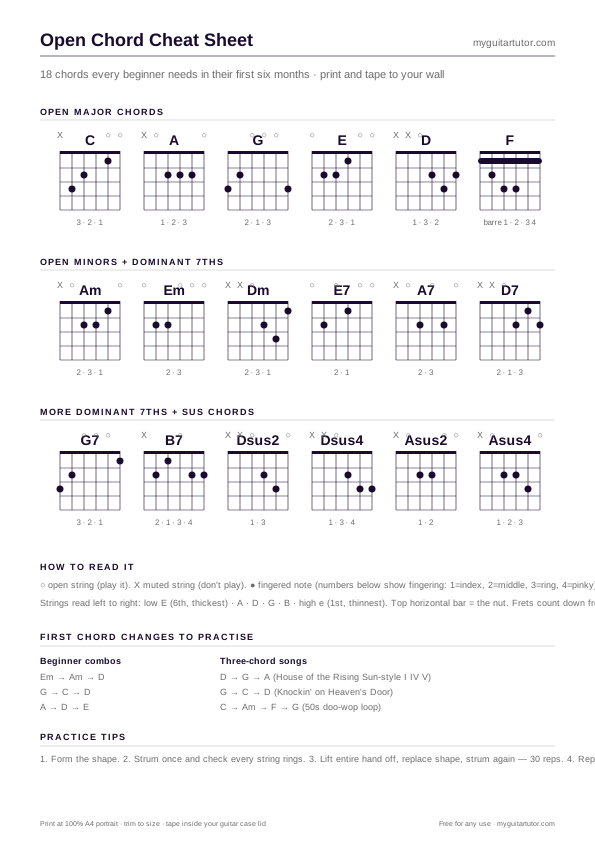
A one-page reference for the 18 most-used open chords — majors, minors, dominant 7s and sus chords. Print and tape to your wall.
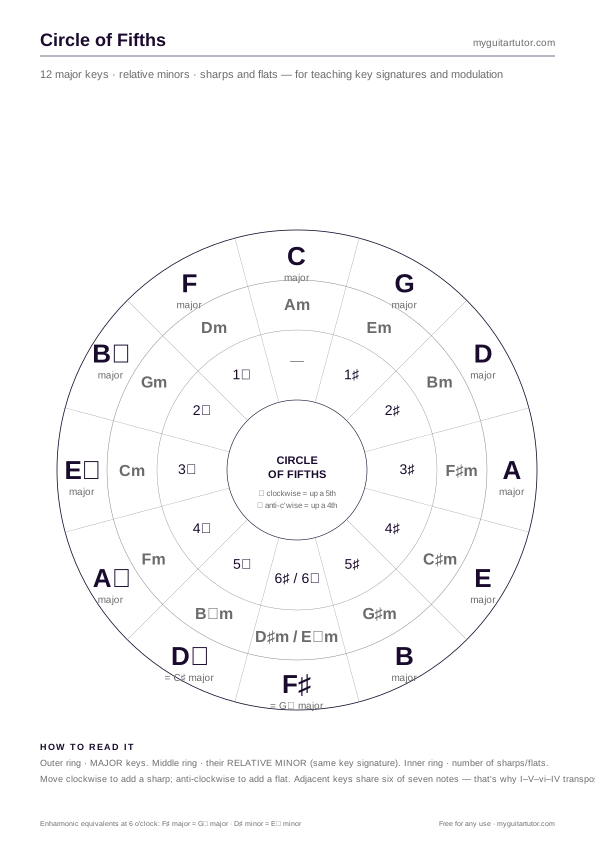
A clean printable circle of fifths with relative minors, sharps and flats. Designed for guitar tutors teaching key signatures and modulation.
Tap-tempo, accent settings, no install. The metronome you actually use because it's already open in a browser tab.
Standard EADGBE tuning detection in the browser. Free, no install, works on phones too.
Browse every scale + mode in any key, with fretboard diagrams. Useful when you want to hear what A minor harmonic or A Dorian look like on the neck.
Drop in Am, Dm, Em, F, G, C and hear the diatonic progressions of A minor in motion. Useful for practising soloing over an actual harmonic context.
A practical guide for guitar teachers on building student practice habits — the set/log/review loop, what to write in homework, common practice-assignment mistakes, and a free printable practice log template for students.
A practical guide for guitar teachers on structuring one-to-one lessons — the five-block format, timing splits for 30/45/60 minute lessons, common planning mistakes, and a free printable lesson plan template.
Most guitar students spend a disproportionate amount of time practising in one or two keys. There’s nothing wrong with this — fluency in a single key is more valuable than tourist-level familiarity with twelve — and A minor is one of the two most common choices (the other being E minor). The reasons are partly historical and partly practical:
Historical: A huge chunk of the rock and blues canon is in A minor or A. The dominant 7 chords of the blues in A — A7, D7, E7 — sit comfortably in first position. The A minor pentatonic became the default lead-guitar scale for half a century of recorded music. If you’re learning by ear from records, you’re mostly learning A-minor and A-blues vocabulary.
Practical: The first-position fingering of the A natural minor scale and the A minor pentatonic both start at fret 5 of the low E. That’s the most ergonomic part of the neck — not so close to the headstock that the frets feel awkwardly wide, not so far up that you’re reaching across your body. The chords (Am, Dm, Em, F, G, C) all use open-position voicings the student already knows. And because A minor has no sharps or flats, the relationship between scale degrees, chord functions and modes is the cleanest possible — you can teach the underlying theory without sharp-and-flat confusion.
Rather than scattering A-minor practice across the library, this hub puts everything in one place. Four printables, four browser tools, two journal pieces. Each one is independently useful; together they’re a complete A-minor practice setup.
The scale chart and fretboard map form the geometric foundation. The major-scale CAGED positions chart shows the five fingerings that transpose to any key — including A minor, which uses the same shapes shifted (A natural minor = C major scale starting on A, so the C-major shapes work without modification, just with A as the tonic instead of C). The fretboard map gives you the absolute reference: which note is at which fret, all six strings, full 24 frets.
The chord chart and the circle of fifths form the harmonic foundation. The open-chord cheat sheet covers Am, Dm, Em, F, C, G — six of the seven diatonic chords in A minor (the seventh, B diminished, is rarely used in practice and gets covered later). The circle of fifths shows you why these chords cluster together harmonically — A minor sits at the C-major position on the inner ring, and the diatonic chords are its neighbours.
The four browser tools are the operational layer. The metronome is non-negotiable for any serious scale work. The tuner ensures you’re actually practising in A minor and not the slightly-flat ghost-of-A-minor your guitar drifted into overnight. The scale generator lets you compare the natural minor with harmonic minor, melodic minor, Dorian, Aeolian and the rest of the family — useful when a student asks “why does this lick sound different from the one we did last week?” The chord progression builder lets you hear A-minor progressions in motion without needing to record yourself.
The two journal pieces sit at the teaching-context layer. “How to get students to actually practice” explains the set-log-review loop that turns “practise A minor pentatonic this week” into something that actually happens between lessons. “How to plan a guitar lesson” puts A-minor work into the broader lesson structure — scale drills go in the technique block, improvisation goes in the repertoire block, and so on.
For an intermediate student aiming for fluency over 8-10 weeks:
Use the lesson planner to structure each week’s session and the practice log to hand the homework over to the student. Track progress on the 12-week progress tracker — “A minor pentatonic position 1 at 120 BPM” makes a great term-end milestone.
You will, eventually. But trying to learn twelve keys simultaneously is the surest way to learn none of them. The pattern that works for most students is: depth in one or two keys (A minor + E minor, or A minor + C major) for the first 6-12 months, then transposition of everything they’ve learned to a third and fourth key, then gradual rollout to the rest. The circle of fifths shows which keys are closest harmonically — start with the immediate neighbours of A minor (C, E minor, G, D minor) before jumping to the far side of the circle.
FAQ
Other curated bundles of resources, tools and writing in adjacent topics.
Beyond A minor — the broader printables library, every PDF in one place.
Reference materials students keep next to the instrument — useful when you want to sketch an A-minor lick on paper.
The teaching-workflow sheets — useful for structuring A-minor practice as homework.