Theory Free · No login · PDF · 119 KB

Circle of Fifths Chart

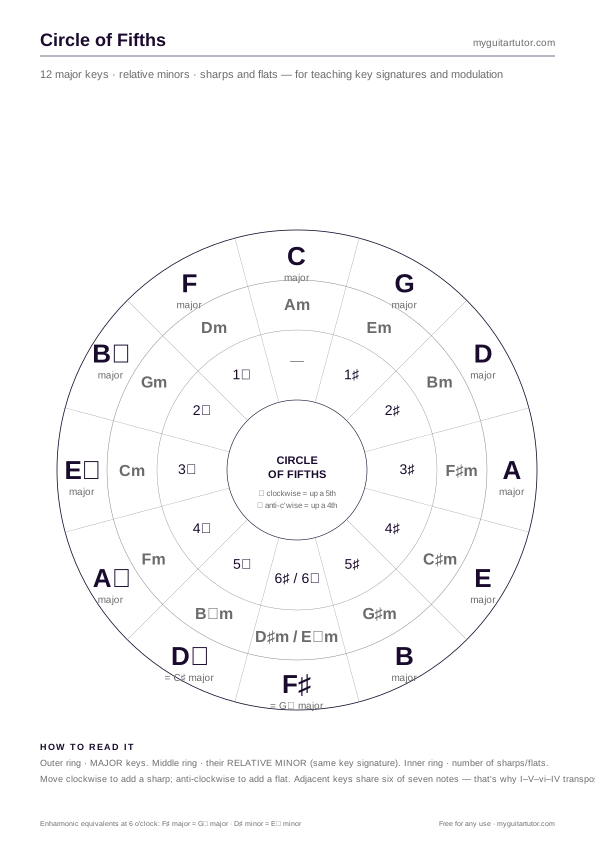
A free printable circle of fifths — clean, uncluttered, guitar-pedagogy-first. All twelve major keys with their relative minors and key signatures. Print as an A4 reference, or scale the SVG up for a teaching-room wall poster.

#circle-of-fifths #theory #key-signatures #reference #printable

Free for personal practice, classroom & lesson use. No attribution required.

What the circle of fifths actually is

The circle of fifths is a visualisation of how the twelve major keys relate to each other. Moving clockwise by a perfect fifth (C → G → D → A → E → B → F# → C# → G# → D# → A# → F → C) walks through all twelve keys in a way that adds one sharp at each step until you flip into flats, then removes one flat at each step. It’s the most useful single diagram in Western music theory.

For a guitar teacher, it’s a one-page answer to “what chords go together?”, “which keys are easy to modulate between?”, “why does it sound right when this song lifts into a different key?”, and “what’s the relative minor of C?”.

The guitar-pedagogy edge

Generic circle-of-fifths charts often clutter the diagram with orchestral information — key signatures rendered in treble and bass clef, modal labels, scale degrees. This version strips all of that out and shows what a guitar student actually uses: the twelve major keys, their relative minors, and the number of sharps or flats. That’s it. Nothing else competes for attention.

When to introduce the circle

For most students, introducing the circle of fifths around lesson 15–20 is the sweet spot. Earlier than that and they don’t yet have enough chord vocabulary to do anything with it; later and they’ve been struggling to make sense of key relationships without the framework. Pin it to the wall, point to it whenever a question comes up. After a term of incidental references, the student knows it cold.

How to use it

How to use the circle of fifths chart

  1. 01

    Read clockwise for sharps, anti-clockwise for flats

    Starting at C (no sharps, no flats) and moving clockwise, each step up a perfect fifth adds one sharp: G has one sharp (F#), D has two (F#, C#), A has three, and so on. Anti-clockwise from C, each step adds one flat: F has one flat (Bb), Bb has two, Eb has three.

  2. 02

    Use the inner ring for relative minors

    Every major key shares a key signature with its relative minor — the inner circle shows them paired up. C major and A minor share no sharps or flats; G major and E minor share one sharp; and so on. This is the single most useful piece of theory for a guitar student learning to navigate keys.

  3. 03

    Spot diatonic chords with the "three-finger trick"

    For any major key, the I, IV and V chords sit on either side of the key on the circle. The vi (relative minor) sits directly opposite at the same clock position on the inner ring. So in C: I = C, IV = F (anti-clockwise neighbour), V = G (clockwise neighbour), vi = Am (inner ring at the C position).

  4. 04

    Use it to plan modulations

    Smooth modulations move by a fifth (clockwise or anti-clockwise) or to the relative minor. Pop songs that "lift" into a brighter key at the final chorus almost always go up a fifth. Show this to a student with the chart in their hand and the theory clicks.

  5. 05

    Pair with the chord progression builder

    Knowing the diatonic chords of a key is one thing. Hearing them in motion is another. Drop the I, IV, V, vi from the chart into the chord progression builder and play through the four most common pop progressions in any key.

FAQ

Quick
answers.

The questions teachers most often ask about this resource — sizing, licensing, how to actually print it.

Why is the circle of fifths useful for guitar specifically?

The fretboard is laid out in fourths (with one major-third interval between strings 2 and 3), which means moving by a fifth maps to a clean visual move on the neck — same shape, different position. The circle of fifths shows you which keys are close to each other harmonically, and the fretboard shows you they're close geometrically too. The two reinforce each other.

Is this the same as the "cycle of fourths"?

Same circle, opposite direction. Read clockwise it's the cycle of fifths (C → G → D → A...). Read anti-clockwise it's the cycle of fourths (C → F → Bb → Eb...). Jazz musicians tend to think in fourths because ii–V–I progressions move down a fifth (= up a fourth); classical theory tends to call it the circle of fifths.

Can I print this larger than A4 for a wall poster?

Yes — use the SVG alternate. SVGs are vector and scale without losing quality. Most online print shops will print an SVG up to A1 or A0 without complaint. Open the SVG in your browser and "save as PNG" at the resolution you want, or upload the SVG directly to a print service.

Do I need to memorise the circle?

Eventually, yes — every working musician knows it cold. Short-term, having it pinned to the teaching room wall and pointing to it when needed is enough. Students typically internalise it after seeing it referenced in 10-20 lessons, no rote memorisation required.

What's the difference between the major and minor versions?

The chart includes both — the outer ring shows major keys, the inner ring shows the relative minors. There's no separate "minor circle of fifths" — minor keys live inside the same circle as their relative majors because they share a key signature.

How does the circle relate to scales?

Every major key on the circle has its own major scale (e.g. G major scale = G A B C D E F#). The number of sharps or flats shown on the circle is the number of accidentals in that scale. For the fingering patterns on guitar, see the five CAGED major scale positions.

Ready?

Grab the pdf.

Download PDF · 119 KB
Keep digging

Related resources.

More templates and charts in the same workflow.