Chord charts Free · No login · PDF · 82 KB

Open Guitar Chords Chart

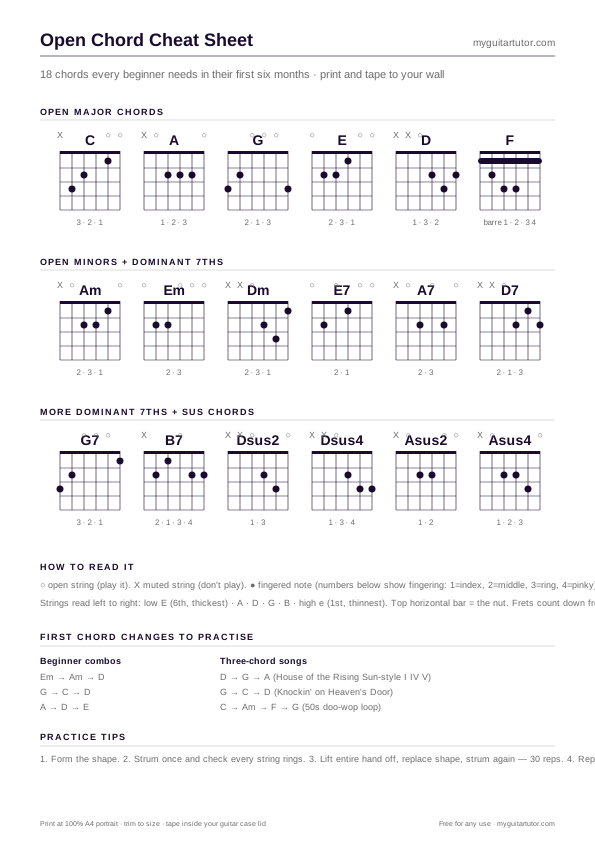
A free one-page open guitar chords chart — the 18 essential open chords every beginner needs in the first six months. Majors, minors, dominant 7s and sus chords with finger numbers. Tape it inside the guitar case lid, or pin it next to the music stand.

#chords #open-chords #cheat-sheet #beginner #reference

Free for personal practice, classroom & lesson use. No attribution required.

The chord vocabulary every beginner needs

Beginner guitar curricula vary, but the chord shortlist doesn’t much. After teaching hundreds of beginners across hundreds of styles, virtually every guitar teacher converges on roughly the same 15–20 open chords as the foundation. This chart codifies them.

The six majors (C, A, G, E, D, F) cover the chord vocabulary of most folk and acoustic singer-songwriter repertoire. The three minors (Am, Em, Dm) add the emotional palette needed for pop and rock. The five dominant 7ths (E7, A7, B7, D7, G7) unlock blues, jazz and bluesy folk. The four sus chords (Dsus2, Dsus4, Asus2, Asus4) cover the most common decorative voicings in modern pop.

Cheat sheet, not exam paper

This is reference material, not a curriculum. Don’t hand the whole sheet to a brand-new student on lesson 1 — that’s overwhelming. Hand it to them after the first lesson with three or four chords circled (the ones you covered today, plus the next one or two coming up). Add a circle each lesson. By month three they’re using the whole sheet.

The “tape it to the wall” rule

There’s a reason this chart is sized as a single A4 page rather than a multi-page reference: it has to live somewhere visible. A reference that lives in a drawer doesn’t get used; a reference that’s taped inside the guitar case lid is the first thing the student sees when they pick up the instrument. Print it, hand it over, tell them where to put it.

When this isn’t enough

These 18 chords get a student through the first 6–12 months of guitar. Beyond that, the next block is barre chords (which unlock all twelve keys), then power chords for rock, then the world of jazz voicings, drop-2 chords, and so on. A “beyond open chords” sheet is on the roadmap.

How to use it

How to use the open chord cheat sheet

  1. 01

    Tape it where the student practises

    Inside the guitar case lid, on the wall next to the music stand, or in the front of their practice folder. The chart only works if it's where the student practises — not in a drawer, not in a bookmark folder. Most students learn chords faster when the diagram is visible without having to reach for a phone or a book.

  2. 02

    Start with three chords: Em, C, G

    These three chords share enough fingers that the transitions between them feel doable in the first lesson. Em → C → G can be played as a strumming exercise on day one. Hundreds of songs use just these three chords plus D — which is your fourth.

  3. 03

    Read finger numbers, not "play with your middle finger"

    The chart uses the standard finger numbering: 1 = index, 2 = middle, 3 = ring, 4 = pinky. Saying "fret 2 of the D string with finger 2" is more precise than physical description. Students who learn the numbers early have a smoother time when they hit barre chords (which use specific fingering for stability).

  4. 04

    Drill chord changes, not just chord shapes

    Holding the chord shape is half the work. The other half is moving between two shapes cleanly. Practise transitions in pairs: C → G, G → D, D → Em, Em → Am. Set a target of 1 clean transition per second by the end of the first month. The metronome helps — see the browser metronome.

  5. 05

    Pair with the weekly practice log

    Once a student knows 4-5 chords, write the chords as the week's exercises on the practice log: "C → G transition × 50, A → D transition × 50, full E → A → D → A loop × 5 minutes." Specific reps beat vague "practise your chords" instructions.

FAQ

Quick
answers.

The questions teachers most often ask about this resource — sizing, licensing, how to actually print it.

Which open chord should a beginner learn first?

Em (E minor). Reason: it uses two fingers, both on the second fret, on adjacent strings. No stretch, no skipping strings, no buzzing if you press anywhere near the fret. Most students can play it cleanly within five minutes of holding the guitar. Em → Am is a natural second pair — same two fingers, slid across to different strings.

Is the F chord on this chart the full barre F or a simplified version?

Both. The chart shows two voicings of F: the full first-position barre (challenging for new beginners), and a four-string Fmaj7 / Fadd voicing that uses only three fingers and no barre. Most beginners use the simplified version for the first two months until grip strength catches up.

Why are there so many sus chords on the cheat sheet?

Sus2 and sus4 chords come up constantly in modern pop and rock — every song that "decorates" between two open chords is using sus voicings. Dsus2 and Dsus4 in particular are the most common pair. Learning them alongside the plain majors and minors gives students harmonic variety without learning new finger shapes (they're modifications of chords they already know).

Is this enough chords to play actual songs?

Yes — these 18 chords cover the vast majority of pop, rock and folk repertoire. The classic "four-chord songs" use I, V, vi, IV (e.g. G, D, Em, C) which are all on this chart. Two-chord and three-chord songs are plentiful. By the time a student needs chords beyond this sheet (barre chords, jazz voicings) they're ready for the next teaching block anyway.

Can I customise the chart to add my own chord voicings?

Yes — download the SVG alternate and open it in Figma, Inkscape, Affinity Designer or Illustrator. Add or swap a chord, change the layout, drop in your studio logo, re-export to PDF. For custom one-off voicings without editing the sheet, use the chord chart generator.

What about left-handed players?

The chart shows right-hand fingerings. For left-handed players, mirror the diagram (a vertical flip): the same finger numbers, mirrored across the vertical axis. A left-handed-specific PDF is on the roadmap — drop a note via the request form on the resources page if you teach a lot of left-handers.

Ready?

Grab the pdf.

Download PDF · 82 KB
Keep digging

Related resources.

More templates and charts in the same workflow.