Fretboard maps Free · No login · PDF · 59 KB

Guitar Fretboard Notes Chart

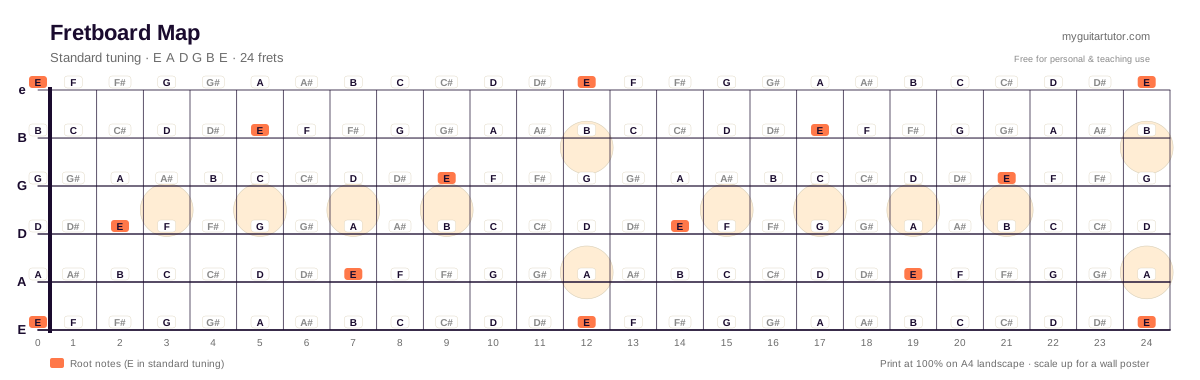
A free printable guitar fretboard notes chart — every note across all 24 frets, standard EADGBE tuning. Sharps labelled inline, inlay dots at the conventional 3-5-7-9-12-15-17-19-21-24 positions. A4 landscape; the SVG scales up cleanly to a wall poster.

#fretboard #notes #standard-tuning #reference #printable

Free for personal practice, classroom & lesson use. No attribution required.

What the chart is for

Knowing every note on the fretboard is one of those skills that separates beginners from intermediate players. Without it, every chord, scale and arpeggio gets memorised as a shape divorced from the underlying notes — which works fine until the student tries to play a song in a different key, or transpose a riff, or follow a chart.

This chart is the reference. Pinned to the teaching-room wall, kept in the back of a student’s practice folder, or printed onto a small card and slipped into the guitar case. Every note, every fret, all six strings, in one diagram.

The two ways to use it

There are two distinct ways students use a fretboard map, and they’re both valid:

  1. As a lookup — “what’s the note at fret 8 on the D string?” Look it up on the chart. Use the answer. Move on. This is the entry point for most beginners.
  2. As a memorisation aid — cover progressively more of the chart, name the hidden notes from memory, repeat until you don’t need it. This is the longer-arc use, and it pays off for years.

Most students need both. Phase one is referencing; phase two is internalising. The chart supports both.

Why standard tuning first

If you only ever learn one tuning’s fretboard cold, make it standard EADGBE. It’s the tuning 95% of guitar music is in, and the tuning every other tuning is described relative to (“drop the low E by a whole step”, “tune the B up a semitone”). Master standard, then layer alternate tunings on top.

For tutors teaching mostly drop-D, DADGAD or open tunings, alternate-tuning versions are on the roadmap. Drop a note via the resource-request box on the resources page.

How to use it

How to use the fretboard notes chart

  1. 01

    Orient the chart the way the guitar sits

    The top row of the chart is the high E string (1st), the bottom row is the low E string (6th). This matches what you see when you look down at the neck while holding the guitar — top of the chart = top of the fretboard.

  2. 02

    Start with the natural notes

    The first pass at fretboard memorisation is the seven natural notes — A, B, C, D, E, F, G — on each string. The chart shows these in the same colour as everything else; the sharps and flats are explicitly labelled. Cover the chart and try to name the natural notes at frets 0, 3, 5, 7, 9, 12 on each string.

  3. 03

    Use the inlay dots as landmarks

    Inlay dots at frets 3, 5, 7, 9, 12 (double dot), 15, 17, 19, 21, 24 are your reference points. Memorise the notes at the dots on each string first. Once you know "fret 5 of the A string is D" and "fret 7 of the E string is B" cold, the in-between frets fall into place.

  4. 04

    Practise the octave shapes

    Any note on the low E string sits one octave higher two frets up on the D string (e.g. low E fret 5 = A; D string fret 7 = A). Similar octave shapes connect the A→G strings (two frets up, two strings up) and the D→B strings (three frets up, two strings up). Knowing octave shapes lets you find any note from any other note in seconds.

  5. 05

    Test yourself with the random-fret game

    Pick a random string and a random fret (or get a student to). Without looking at the chart, name the note. Aim for sub-second recall on the natural notes first, then the sharps and flats. Five minutes a day for two weeks gets most students to fluency.

FAQ

Quick
answers.

The questions teachers most often ask about this resource — sizing, licensing, how to actually print it.

Should I memorise the whole fretboard or just up to fret 12?

Both — but in stages. Frets 0–12 first, because they're the half of the neck where most playing happens. Frets 13–24 repeat the same notes one octave higher — so once you know 0–12, the rest is essentially free.

Why does the chart use sharps and not flats?

Sharps are the convention for ascending lines and for most rock/pop guitar contexts. The chart labels the black keys with their sharp names (F#, C#, G#, etc.); the flat names (Gb, Db, Ab) are enharmonic equivalents — same pitch, different name depending on key. For flat-heavy contexts like jazz in Bb, the rename is straightforward.

What if I play in drop-D, DADGAD, or open tunings?

This chart is specific to standard EADGBE. Drop-D differs only on the low string (which becomes D); DADGAD and open tunings differ across most strings. Tuning-specific charts are on the roadmap — drop a note via the resource-request box on the main resources page if there's a specific tuning you teach a lot.

Print at A4 or A3?

A4 landscape works as a desk or music-stand reference. For a teaching-room wall poster, the SVG scales up cleanly to A3, A2 or even A1 without losing quality. Most online print shops accept SVG uploads directly.

How long does fretboard memorisation usually take?

For a motivated student practising five minutes a day with the chart: 2–3 weeks for the natural notes at the dots, 6–8 weeks for full fluency across all strings and frets. Less-motivated students can drift for months without ever consolidating it — which is why a teacher actively running through fretboard quizzes during the warm-up block matters. See How to plan a guitar lesson.

How does this relate to the CAGED scale shapes?

The fretboard map shows you where the notes are; the CAGED scale positions show you which notes belong to a key. Together they're a complete picture: the map says fret 5 of the A string is D, and the scale shapes say D is the root of the D major scale shape that starts on the same fret.

Ready?

Grab the pdf.

Download PDF · 59 KB
Keep digging

Related resources.

More templates and charts in the same workflow.